News

Beyond the Averages: What London’s Rental Market Really Tells Us

Headline averages are useful but they only scratch the surface. To truly understand the dynamics of London’s rental market it is essential to look borough by borough. While certain themes run consistently across the capital the data also reveals striking local contrasts.

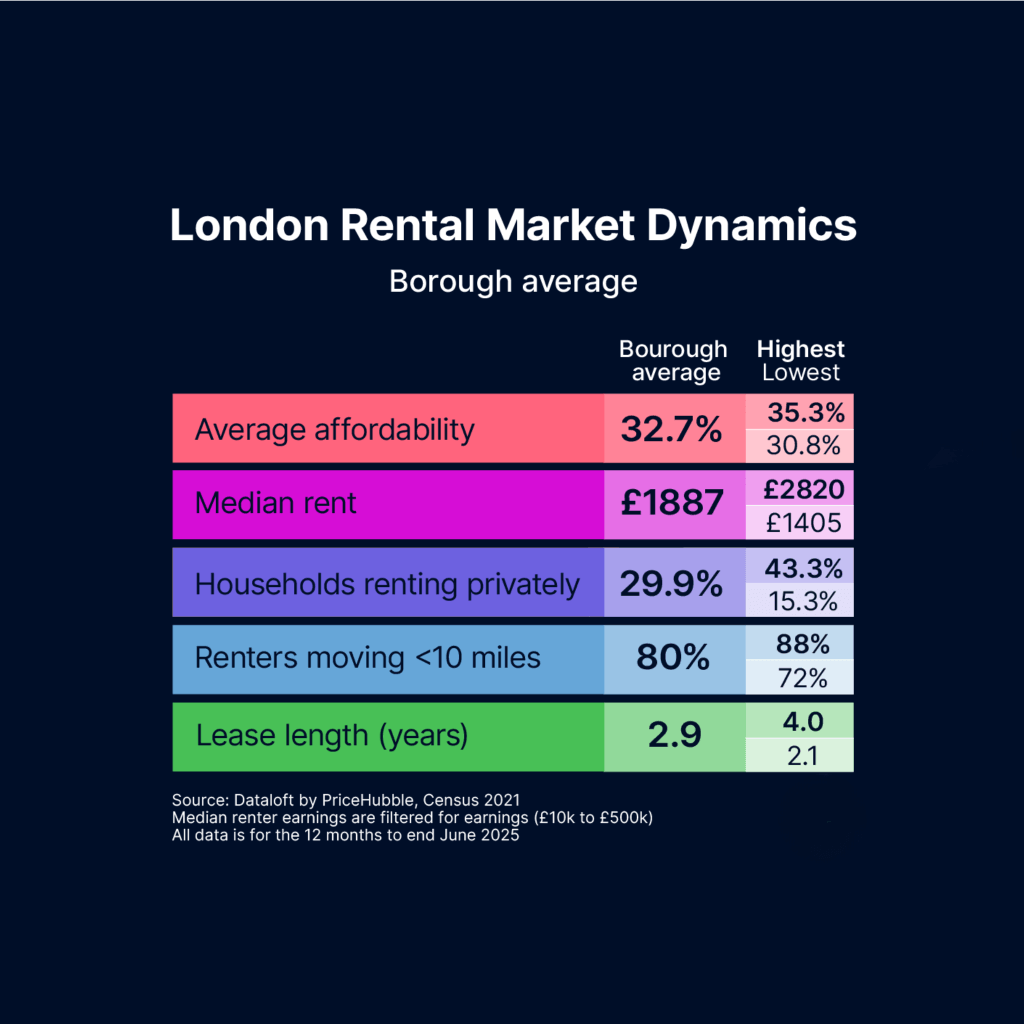
Across all London boroughs renters are devoting more than 30% of their income to rent. Havering sits at the lowest end of the spectrum at 30.1% while Hammersmith & Fulham tops the chart at 35.3%. This underlines the universal pressure that rent places on household budgets regardless of location.

The average rent in London now stands at £1,887 per calendar month. Yet the borough breakdown shows wide disparities. Kensington & Chelsea commands the highest rents at £2,820 pcm while Bexley offers the most affordable average at £1,405 pcm. For tenants this gap highlights just how dramatically housing costs can shift depending on postcode.

Another area of divergence lies in the proportion of households relying on the private rental sector. Bexley has the smallest share at 15% whereas Westminster sees almost half its households—43%—renting privately. Such figures demonstrate how ingrained private renting has become in some parts of London compared with others where homeownership still holds greater sway.

London’s rental market is also highly localised. On average 80% of new lets are taken by renters moving within a 10-mile radius. This reflects not only lifestyle preferences but also the strong pull of community ties, workplaces or local amenities. The average lease length across London is 2.9 years but this masks variation. Some boroughs see tenants staying for just 2.1 years while in others leases stretch to 4 years. These patterns reveal different levels of stability or transience in local rental markets.

The capital’s averages provide a useful headline but the borough-level data paints a much richer picture. From affordability pressures to the dominance of renting in certain areas London’s rental market is shaped by local realities as much as citywide trends.

Beyond the Averages: What London’s Rental Market Really Tells Us Read More »

Solid Summer Sales

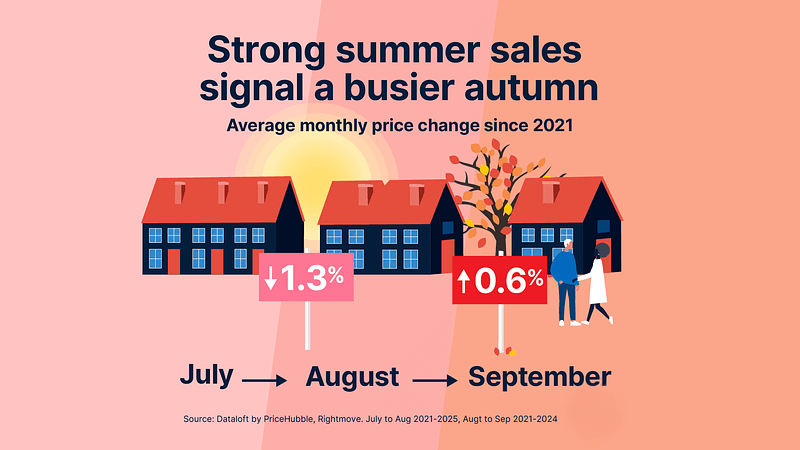
Here we can see how housing transactions are spread across the seasons– and the results might surprise you. While summer (June to August) has the smallest share of annual sales at 24.2%, it still holds its own compared with the other seasons. Spring comes out on top with 25.7%, winter follows closely at 25.4% and autumn sits just ahead of summer at 24.7%.

What is most striking is how evenly balanced these figures are. The differences between seasons are very small, showing that the property market remains active throughout the entire year. Summer may not lead in volume but it certainly does not fall far behind.

For buyers and sellers, this is reassuring news. It challenges the belief that summer is a quiet time for the housing market. In reality, summer sales remain strong and prove that opportunities to buy or sell are not limited to a particular season. Whether it is spring, summer, autumn or winter, the housing market continues to move.

Solid Summer Sales Read More »

Buyer Confidence Rises 2025

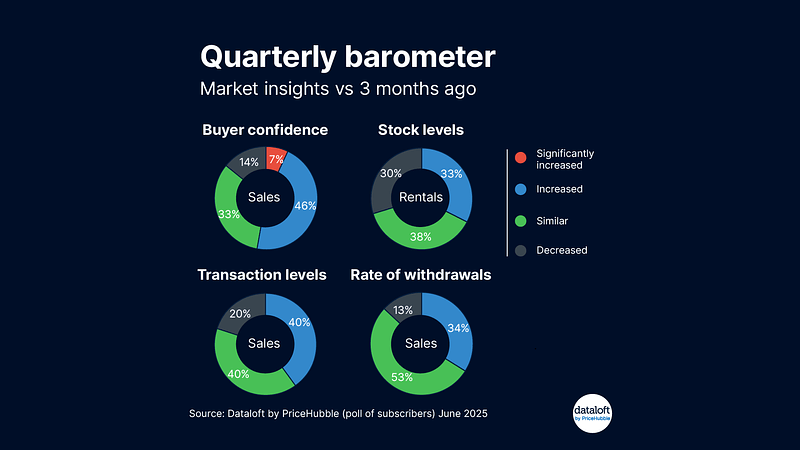
Falling mortgage rates have helped boost buyer confidence. Just over one out of two agents said conditions have improved since the last quarter. Buyer sentiment is picking up too — 46% noticed more confidence, one out of three said levels were unchanged while only 7% saw a significant jump. This shows a steady upward trend without major shifts.

Following the stamp duty lull, transaction volumes bounced back strongly between April and May, rising by 25%. Still, only 40% of agents felt transaction levels matched the previous quarter. Meanwhile, 20% reported a decline, pointing to a recovery that’s still uneven.

Sales withdrawals remain stable. Around one out of two agents said the rate hasn’t changed while 34% noticed a decrease and 13% saw an increase. This suggests most sellers are staying the course.

In the rental sector, demand is steady but supply is tight. 38% of agents reported a drop in available rental properties, one out of three said levels have stayed the same while 30% saw an increase. This reflects growing pressure on rental stock.

Overall, the data suggests a market regaining momentum, led by improving buyer confidence and rising transactions though supply challenges and regional differences remain.

Buyer Confidence Rises 2025 Read More »

Homes taking just over a month to sell

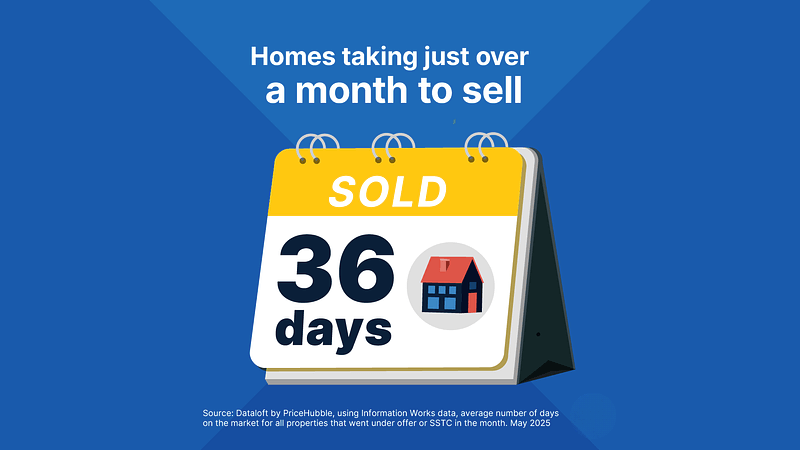
Thinking of selling your home? Here’s a quick look at how the market is moving. In April, the average time it took to sell a home in the UK was 36 days — a slight improvement from the 38-day average seen during the first quarter of the year. This uptick in pace follows typical seasonal patterns, as spring usually brings more buyers into the market. On average, homes sell around five days faster in the second quarter compared to Q1, and about ten days quicker than in the final quarter of the year.

There were some notable regional shifts too. The North East saw the fastest sales, with homes selling 12 days quicker than the national average. The West Midlands also outperformed, with homes going under offer four days faster than average. At the other end of the scale, London continued to see the slowest sales, with homes taking 41 days on average to sell — though that’s still a three-day improvement on the previous quarter.

If you’re thinking about making a move, now might be a great time to explore your options. Curious how quickly homes are selling in your area? We’re here to help — let’s have a chat.

Homes taking just over a month to sell Read More »

Community counts

The Sunday Times’ Best Place to Live in the UK 2025 emphasizes that quality of life extends beyond conventional metrics such as school performance or broadband speed.

Central to its evaluation is the presence of a strong local community, a factor that significantly influences residential satisfaction and longevity, particularly among renters—69% of whom would choose to remain in an area longer if they perceived a strong sense of community, as highlighted in data from Dataloft.

Additional criteria included effective transport links, cultural accessibility, green spaces, and a vibrant high street. The report showcases diverse regional winners, ranging from the rural charm of Ilmington in the Midlands and coastal North Berwick in Scotland to the urban vibrancy of Walthamstow in London. Among all, Saffron Walden emerged as the overall winner, distinguished by its historic architecture, high-quality state education, rich cultural life, and strong commuter connectivity—factors that collectively underscore its exceptional community fabric and livability.

Community counts Read More »

New homes growing in popularity

The appeal of newly constructed homes continues to rise among prospective home movers, as evidenced by data from the Home Moving Trends Survey 2024. In 2025, 53% of respondents expressed a willingness to consider buying a new build, a notable increase from 47% in 2024.

Moreover, the proportion of individuals who prefer to buy a new home has grown from 17% to 21% over the same period. This upward trend in consumer preference aligns with the UK government’s strategic goal to deliver 1.5 million new homes over the next five years, signalling a robust national commitment to housing development.

Concurrently, 64% of developers anticipate growth in housebuilding activity within the next 12 months, reinforcing the sector’s readiness to meet this demand. The convergence of rising buyer interest and governmental support presents a significant opportunity for the housing market, particularly in the realm of new build properties.

New homes growing in popularity Read More »

Market Outlook: Climbing Rental Yields

Over the past five years, average gross rental yields across England and Wales have consistently increased, reaching a peak of 7.2% in February 2025, compared to 6% in 2020. This upward trend is evident across all regions, with the North West experiencing the most significant rise from 6.1% to 7.8%. The primary driver behind yield growth is rental inflation surpassing house price inflation, as average rents have surged by 44% over five years, whereas property sales prices have risen by 20%. Flats now yield an average of 7.4%, a sharp increase from 5.4% in 2020, while houses yield 5.7%, up from 5.1%.

Despite these high gross rental yields, increasing regulatory pressures have posed challenges for landlords. Nevertheless, 71% of landlords intend to maintain their property portfolios over the next year, an increase from 66%, while 9% plan to expand. These figures are based on data from Dataloft by PriceHubble and the Land Registry, with calculations derived from a rolling 12-month basis of average sales and rental prices on a per-square-foot basis.

Market Outlook: Climbing Rental Yields Read More »

The Rise Of Co-Living

In a world of constant innovation, long-established domestic arrangements are fading, and modernist living is taking a step forward. The latest idea of “co-living” has emerged, described as “large-scale purpose-built shared living developments of at least 50 units” by The London Plan. Co-living presents an alternative to traditional flat shares, showcasing a structured yet flexible approach to shared living, incorporating additional services and amenities, with leases requiring a minimum stay of three months.

Whilst initially assumed to only attract younger demographics, with statistics showing an average resident age of 28 years old, co-living debunks such assumptions, having 20% of occupants over 35. With constant room for improvement, the potential for age-specific developments is expanding, with the ability to cater to varying demographic needs. Beyond affordability, co-living is valued for its convenience, flexibility, and a strong sense of community.

Moreover, co-living plays a significant role in addressing the growing housing demand, with each unit contributing to broader availability. It also serves as a solution to long-term housing challenges, with 70% of residents planning to stay for a year or longer. This evolving model reflects shifting preferences in urban living, emphasizing shared experiences and adaptable lifestyle solutions.

The Rise Of Co-Living Read More »

Spring Statement 2025

The Spring Statement of 2025 presented a mixed economic outlook, with a significant downgrade in the UK’s growth forecast for 2025, halving to just 1%. However, a positive development emerged in the form of new housebuilding projections from the Office for Budgetary Responsibility (OBR).

According to the OBR’s modeling, government reforms to planning policies introduced the previous year are expected to have a “material” impact on housebuilding activity. These reforms are projected to contribute to an increase in housebuilding levels, with numbers potentially reaching over 305,000 by 2029. Despite this long-term growth projection, the short-term forecast indicates a decline in housebuilding before any meaningful recovery occurs.

In 2024, housebuilding levels stood at approximately 244,000, significantly below the pre-pandemic peak of 287,000 recorded in 2019, which was the highest level in at least 15 years. The OBR acknowledged that planning reforms would help counteract some of the adverse effects of rising construction costs and higher interest rates, which have posed challenges to the housing sector. The analysis covers historical data for England, Wales, and Scotland and underscores the gradual nature of policy-driven improvements in the housing market. 

Spring Statement 2025 Read More »

Hook a new home

March traditionally marks a peak period for property sellers, and in 2025, the market has seen a significant increase in supply, reaching the highest level of competition in a decade. This surge in available properties provides buyers with the broadest selection since 2015, though those entering the market now are unlikely to meet the current month’s stamp duty deadline.

A notable 52% of agents have reported a rise in sales market supply compared to three months prior, reinforcing the trend of increased inventory. However, with affordability constraints persisting in certain areas and buyers having more options than in previous years, sellers must adopt competitive pricing strategies to secure sales.

The heightened level of choice underscores the necessity for strategic pricing and market awareness in order to navigate this evolving housing market landscape effectively.

Hook a new home Read More »

Scroll to Top